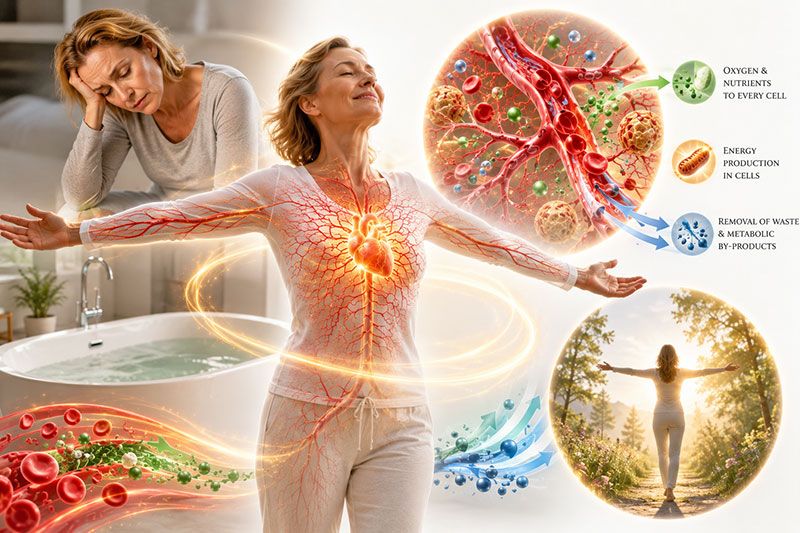
Energy Is Created in the Cells
The human body contains trillions of living cells.
Every heartbeat.
Every thought.
Every movement.
Every process of repair.
All depend upon energy produced inside these cells.
Yet no cell can generate energy without a continuous supply of oxygen and nutrients.
Nor can it function efficiently if metabolic waste accumulates around it.
This exchange occurs within one extraordinary system:
the capillary network.
The Capillaries: The True Suppliers of Life
The heart can pump blood.
The arteries can transport it.
The veins can return it.
But only the capillaries deliver life directly to the tissues.
Here oxygen leaves the blood.
Here nutrients reach the cells.
Here carbon dioxide and metabolic by-products begin their return journey.
Without healthy capillary circulation, the body's ability to produce and sustain energy gradually declines.
The Forgotten Millions of Peripheral HeartsLong before modern imaging technologies revealed the complexity of the microcirculation, physiologists recognized that the smallest blood vessels were remarkably active.
In The Secret Wisdom of the Human Body, Dr. Zalmanov referred to the work of Henri Huchard, Rouget, Tinel, and Clarke, who described the capillary network as an immense system of "peripheral hearts."
He wrote:
"
As early as 1908, Huchard established the importance of innumerable peripheral hearts. Rouget emphasized the muscular character of the cells that bear his name. For Tinel, the Rouget cells constitute a neuromuscular apparatus. Capillary contractions—rhythmic capillary systoles—are indisputable for both Tinel and Clarke."
The Secret Wisdom of the Human Body.pdf
These scientists believed that the smallest vessels actively participated in the movement and regulation of blood rather than serving as passive channels.
Modern physiology explains microcirculation differently today, but one principle remains unchanged:
Healthy tissues depend upon healthy blood flow.
Fatigue and Cellular ExchangeDr. Zalmanov often described health as a process of continuous exchange.
Life depends upon movement.
Oxygen must move into tissues.
Nutrients must move into cells.
Metabolic waste must move out.
When this exchange becomes less efficient, tissues may no longer function at their full potential.
The body may respond with:
• Reduced energy
• Slower recovery
• Mental fatigue
• Physical tiredness
• Loss of vitality
• Reduced tolerance to stress
For Zalmanov, fatigue was often a sign that the body's microscopic circulation deserved attention.
Why Dr. Zalmanov Developed Turpentine Baths
raditional White and Yellow Turpentine Bath Emulsions were developed to stimulate the capillary network through warm therapeutic baths.
The skin warms.
Peripheral circulation becomes more active.
Perspiration begins.
The body's natural circulatory responses are engaged.
Dr. Zalmanov described the purpose of his method as:
Oxygen delivery.
Cellular nutrition.
Removal of metabolic waste.
All depend upon healthy circulation.
Chronic Fatigue and RecoveryAccording to Dr. Zalmanov's philosophy, recovery begins not with stimulation but with restoration.
The body must first regain its ability to nourish itself.
Every organ depends upon circulation.
Every muscle depends upon circulation.
The nervous system depends upon circulation.
The endocrine system depends upon circulation.
The brain depends upon circulation.
The body's remarkable capacity for recovery begins with the delivery of oxygen and nutrients to the cells.
A Modern Physiological Perspective
Modern science recognizes that energy production depends upon efficient oxygen delivery, mitochondrial activity, tissue perfusion, autonomic regulation, sleep quality, nutrition, and many other physiological factors.
Chronic fatigue can have numerous medical causes and should always be properly evaluated by a healthcare professional.
However, modern physiology also confirms the importance of:
• Microcirculation
• Tissue perfusion
• Oxygen delivery
• Nutrient transport
• Cellular metabolism
• Thermoregulation
These principles closely align with many of the foundational ideas that guided Dr. Zalmanov's work.
The Zalmanov Method TodayTraditional Turpentine Bath Therapy continues to follow the philosophy that inspired Dr. Zalmanov more than a century ago.
Rather than focusing on symptoms alone, it seeks to support the body's natural circulatory processes through the extensive capillary network of the skin.
Our White and Yellow Turpentine Bath Emulsions are prepared according to the original principles of Dr. Zalmanov's capillary therapy.
They are intended to support:
• Healthy blood circulation
• Active microcirculation
• Oxygen delivery
• Cellular nutrition
• Natural perspiration
• Physiological recovery
• Energy metabolism
• Whole-body vitality
Because every cell depends upon circulation.
And vitality begins where blood meets the cell.
Before the body can regain its strength, the cells must regain their nourishment FAQ
What is chronic fatigue according to Dr. Zalmanov's philosophy?
Dr. Zalmanov viewed persistent fatigue as a sign that the body's cells may not be receiving optimal oxygen, nutrients, and circulatory support through the capillary network.
Why did Zalmanov focus on capillaries?
Because capillaries are the vessels where oxygen and nutrients enter tissues and metabolic waste leaves them. He believed healthy microcirculation was essential for vitality.
How do turpentine baths fit into chronic fatigue recovery?
According to Dr. Zalmanov, traditional turpentine bath therapy was developed to stimulate the skin's capillary network and support healthy circulation throughout the body.